



Search for answers or browse our knowledge base.
Check for a water leak
STEP 1:Turn off all equipment in your home that uses water.
Make sure to check all faucets and appliances before you begin.
STEP 2: Find your water meter.
Your water meter can be a very useful tool in determining whether you have a water leak. It is usually located in a black rectangular meter box located in the easement close to the street. Be cautious when opening the lid to the meter box, as sometimes the meter box will become home to insects, spiders, frogs, and yes, even a snake. Once you have the meter box opened, it may be necessary to wipe off the face of the meter in order to see it clearly.
Find the low flow detector on your water meter. Your meter is equipped with a low flow detector that rotates in a clockwise direction when water is being used. Use the images below as a guide.
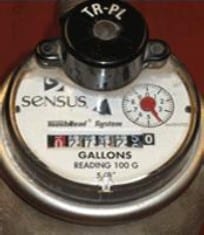
METER A
On this type of meter, the low flow detector is a black triangle, dead center above the read numbers.
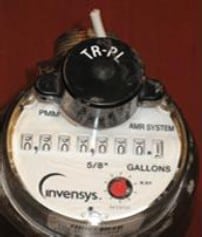
METER B
On this type of meter, the low flow detector is a small red knob located in the bottom right hand corner of the meter.
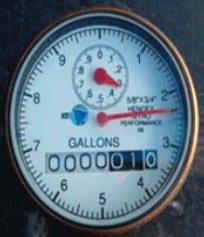
METER C
On this type of meter, the low flow detector is a red (sometimes black) triangle above the read numbers, just left of the large red hand.
Use the low-flow detector to monitor usage. Watch the low flow detector very closely. If there is any movement in the low flow detector, and you are sure everything that uses water has been turned off, that is an indication that there is a leak. The speed at which the low flow detector moves indicates how large the leak is.
STEP 3: Fix the leak.
If you found a leak, the next step is finding the source of the leak and stopping it. Continuous leaks as small as 1/16th of an inch can cause water waste as much as 24,667 gallons in a month. A dripping faucet can waste 3 gallons a day or 1095 gallons a year. Finding and repairing a leak saves water and money.
Water leaks come in many sizes and varieties. Some water leaks require the expertise of a plumber and the resident can easily repair others. Some of the most common sources of water leaking are sprinkler systems, toilets, and faucets.
Before calling a plumber, here are a few things you can try:
- Add a few drops of food coloring to the tank of the toilet. Wait a few minutes and then look for any color seeping into the bowl. If there is color, then the toilet is leaking.
- While slowly walking the trench line between your meter and your home, look for any “squishy” areas.
- Look for any areas of the yard that are unusually green.